
The Complete Guide to DISC: Understand Work Styles and Unlock Team Potential
Take DISC Personality Profile Test
Get StartedWhat Is the DISC Framework and How Does It Help?
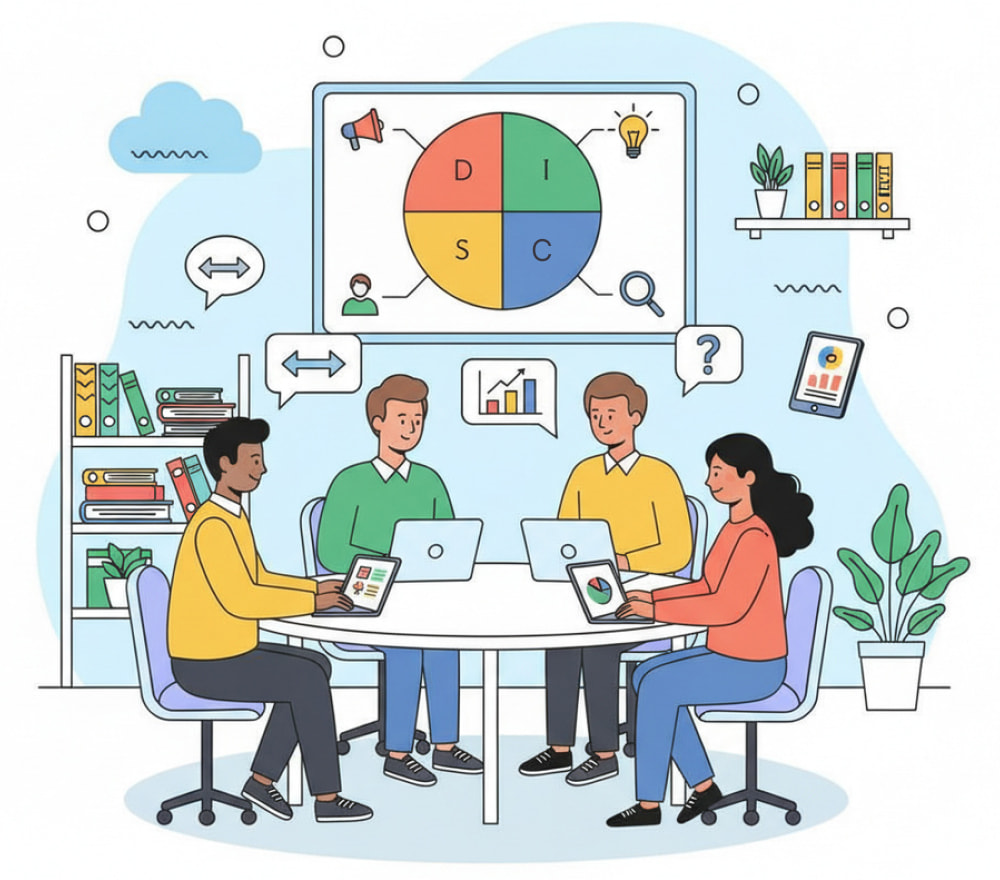
DISC is a practical behavioral model that categorizes observable tendencies into four primary styles: Dominance, Influence, Steadiness, and Conscientiousness. By focusing on what people do and how they do it, the model equips professionals with a shared language for communication, conflict resolution, and collaboration. Unlike personality theories that feel abstract, this framework maps directly to day-to-day actions, making it easy to use in interviews, coaching sessions, and performance dialogues. Organizations adopt the approach because it scales neatly from individuals to teams to entire departments, all while remaining simple enough to remember under pressure.
Learning the framework is straightforward, and you can apply insights immediately to improve meetings, feedback loops, and handoffs. Whether you are new to behavioral models or returning for a refresher, you can explore DISC assessment free choices to sample the experience. Those who prefer offline review can select a DISC personality test free download option to read insights without an internet connection.
- Clarify how you respond to pace, pressure, and change.
- Spot triggers that cause friction and plan preventative moves.
- Adapt messages to match another person’s decision-making cadence.
- Reduce ambiguity in roles, goals, and ownership during projects.
- Build a resilient vocabulary for feedback that avoids personal judgments.
Key Benefits for Individuals and Teams
When used responsibly, DISC accelerates self-awareness, shortens the path to trust, and creates predictable collaboration patterns. Individuals gain language to describe needs without sounding defensive, while managers gain a toolkit for clearer expectations. Teams benefit from a common playbook for handoffs and hot-button scenarios like deadlines, escalations, and retrospectives. Over time, the model improves engagement by making psychological safety concrete and teachable rather than vague and aspirational.
Learners who prefer a quick diagnostic often try a DISC personality test free alternative to get a snapshot of their dominant style. If budgeting is tight, you can still benchmark your tendencies with a DISC test for free that highlights strengths without paywalls.
- Accelerate onboarding by translating roles into observable behaviors.
- Strengthen 1:1s with structured prompts tailored to each style.
- Reduce rework by aligning communication norms before execution starts.
- De-escalate conflict by separating intention from impact with neutral language.
- Create repeatable rituals for retros, standups, and decision-making forums.
Choose the Right Path: Quick Screeners and Deep Dives
Not every situation needs the same level of rigor, and matching the method to your goal keeps momentum high. Short screeners can spark dialogue during a kickoff, while a fuller debrief can anchor a quarterly offsite or performance cycle. HR may pilot a minimal approach to validate interest, then grow into a more comprehensive program once leaders see measurable gains. The comparison below helps you decide what to use and when.
| Use Case | What You’ll Learn | Time Required | Next Step |
|---|---|---|---|
| Personal quick check | Primary tendencies and blind spots | 8–12 minutes | Skim a summary and set 1 improvement goal |
| Team kickoff | Collaboration norms and handoff preferences | 30–60 minutes | Draft working agreements and revisit in 2 weeks |
| Leadership coaching | Decision pace, feedback style, and stress reactions | 90 minutes | Build an action plan with accountability milestones |
| Change initiative | Stakeholder mapping and influence tactics | 2–3 hours | Set a communication cadence aligned to styles |
When comparing options, look for a free DISC assessment test that balances brevity with reliability and offers clear debrief notes. Credible versions explain how items map to the four factors and provide practical adjustments you can apply in your next meeting or email.
Once finished, download summaries or request a free DISC profile to share highlights with a mentor. That artifact becomes a living reference you can update as your responsibilities evolve or as team composition changes.
- Align assessment depth with the complexity of your decision.
- Document one behavior to start, one to stop, and one to continue.
- Revisit agreements after milestones to keep habits sticky.
How to Take DISC Online and Interpret the Results
Getting started is quick, and thoughtful preparation makes the output more actionable. Set aside uninterrupted time, respond based on typical work behavior rather than aspirations, and avoid gaming the system. After you receive your style pattern, confirm the resonance by reflecting on your recent projects, stakeholder feedback, and moments you felt “in the zone.” Then convert the insights into one or two experiments you can test this week.
Remote workers appreciate a DISC assessment online free path that runs smoothly on mobile and respects their privacy. After completing the questionnaire, many people save their link to a free DISC assessment online portal so they can revisit results later.
- Skim your overview, then read the strengths and stress sections in detail.
- Write two phrases you can say when you need to set boundaries constructively.
- Identify a colleague with a different pace and plan a small co-working pilot.
- Translate insights into calendar nudges and checklist prompts.
- Share a one-page summary with your manager before your next 1:1.
Ethical Use, Coaching Tips, and Next Steps
DISC should inform decisions without becoming a label or excuse. The most effective practitioners treat the model as a hypothesis generator, not a verdict about identity. Leaders who model curiosity and humility create space for nuance, context, and growth. With that mindset, the framework turns into a catalyst for continuous improvement rather than a static profile.
For quick team check-ins, a free DISC test can reorient DISCussions toward concrete behaviors and expectations. In coaching dialogues, prompt for examples, probe for context, and co-create experiments that feel safe-to-try within current constraints.
In group settings, a DISC free test used alongside norms and charters can prevent bias by anchoring on behavior. Pair the results with observational feedback and real work artifacts, and you will keep conversations grounded in evidence rather than assumptions.
- Never use results to gate opportunities or justify inequity.
- Rotate facilitation and note-taking to honor diverse strengths.
- Reassess norms when team composition or strategy shifts.
- Measure outcomes with clear metrics like cycle time, satisfaction, and quality.
FAQ: Common Questions About DISC
How accurate is a short screener compared to long-form diagnostics?
Short forms are excellent for awareness and shared language, while longer versions may add depth on stress responses and communication nuances. For many workflows, the lighter approach is enough to change habits and improve collaboration. Managers who sponsor development sometimes start teammates on a free DISC personality test as an icebreaker before deeper coaching.
What does a healthy follow-up look like after I get my results?
A strong follow-up translates insights into one small behavior experiment tied to a real deadline. Pair the experiment with a brief check-in two weeks later to evaluate what worked and what needs refinement. If budgeting or access is limited, you can still build momentum with a DISC free assessment that supports reflection and planning.
Can teams roll this out without a facilitator?
Yes, as long as you set clear objectives, time-box the conversation, and agree on working norms at the end. Prepare prompts in advance, like “What do you need more or less of from me?” and rotate who facilitates. Keep the DISCussion practical by anchoring on specific meetings, documents, and handoffs.
Is there a way to try DISC without committing to a full program?
Pilots are a smart way to test fit in your context, particularly when change fatigue is high. For HR pilots, a limited-scope DISC free assessment may validate the approach before scaling it to an entire department. Document lessons learned so you can refine content and cadence for broader adoption.
How do I support remote colleagues who prefer asynchronous work?
Offer flexible participation options, including text-based reflections and staggered deadlines. Those colleagues may value written debriefs and concise summaries they can review on their own schedule. Managers can also provide an optional check-in to clarify insights and plan next steps at a comfortable pace.